

Virtual Networking Market to Reach US$ 138.5 Billion by 2033 Amid Cloud and 5G Acceleration
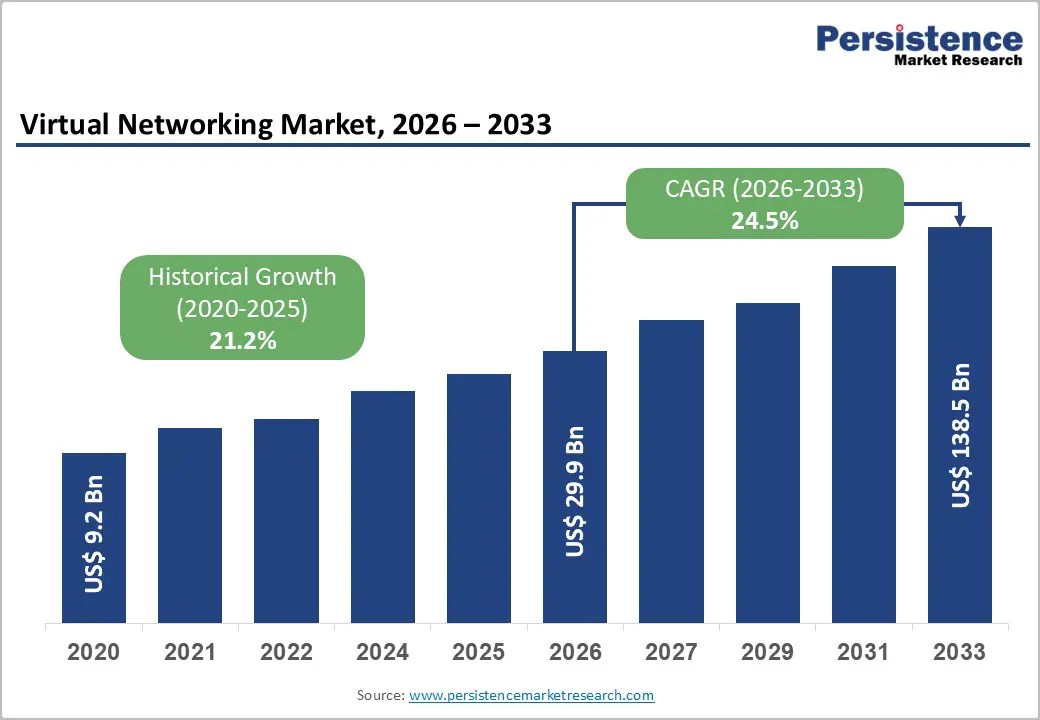
The Virtual Networking market is set to grow from US$ 29.9 Bn in 2026 to US$ 138.5 Bn by 2033, expanding at a robust CAGR of 24.5% during this period
BRENTFORD, ENGLAND, UNITED KINGDOM, March 2, 2026 /EINPresswire.com/ -- The Virtual Networking Market is witnessing rapid expansion as enterprises and telecommunications operators transition from hardware-centric architectures to software-defined, cloud-native network infrastructures. Valued at US$ 29.9 billion in 2026, the market is projected to reach US$ 138.5 billion by 2033, growing at a strong CAGR of 24.5% during the forecast period.
This growth reflects the global shift toward software-defined networking (SDN), network function virtualization (NFV), SD-WAN adoption, and cloud-based network orchestration. Organizations across IT & telecommunications, BFSI, healthcare, and manufacturing are modernizing network infrastructure to support hybrid workforces, multi-cloud deployments, 5G rollouts, and edge computing.
Virtual networking enables centralized management, automated provisioning, policy-based configuration, and scalable infrastructure, reducing reliance on proprietary hardware appliances. As digital transformation accelerates globally, virtual networking has become foundational to enterprise IT modernization strategies.
𝐆𝐞𝐭 𝐚 𝐒𝐚𝐦𝐩𝐥𝐞 𝐏𝐃𝐅 𝐁𝐫𝐨𝐜𝐡𝐮𝐫𝐞 𝐨𝐟 𝐭𝐡𝐞 𝐑𝐞𝐩𝐨𝐫𝐭: https://www.persistencemarketresearch.com/samples/14581
Market Dynamics
Growth Driver: Telecommunications Virtualization and 5G Deployment
Telecommunications infrastructure virtualization is a major catalyst for the Virtual Networking Market. As operators migrate from proprietary hardware to cloud-native architectures, NFV and SDN enable dynamic service provisioning, faster rollout of new services, and operational cost efficiency.
India’s telecom ecosystem exemplifies this transformation, with over 1.21 billion subscribers and rapidly expanding 5G adoption. The shift toward virtualized core networks and software-driven routing systems enables telecom operators to scale bandwidth efficiently while reducing hardware dependencies.
On April 3, 2025, 6WIND partnered with Dense Air to deploy virtualized security gateway (vSecGW) and virtual cell site router (vCSR) solutions supporting multi-operator 5G infrastructure. Such partnerships demonstrate how virtual networking underpins 5G scalability and network slicing capabilities.
With global internet users approaching 6 billion by 2025, telecommunications operators must adopt programmable, scalable networking solutions, directly benefiting the Virtual Networking Market.
Growth Driver: Cloud Adoption and Enterprise Digital Transformation
Enterprises are rapidly migrating workloads to hybrid and multi-cloud environments, creating strong demand for virtual networking solutions that ensure secure, seamless connectivity across distributed cloud infrastructures.
On April 8, 2025, Hewlett Packard Enterprise expanded its Aruba Networking Central platform to include virtual private cloud (VPC) and on-premises deployment options, enhancing AI-powered network optimization and observability. Such advancements address enterprise data sovereignty requirements and regulatory compliance needs.
The rapid growth of B2B eCommerce, digital procurement platforms, and API-driven ecosystems further amplifies demand for secure SD-WAN and SASE (Secure Access Service Edge) architectures. Virtual networking enables automated provisioning, centralized policy enforcement, and cost-efficient scaling—essential for enterprises operating globally distributed infrastructures.
Market Restraints
Performance and Latency Concerns
Despite strong adoption trends, concerns regarding network performance and latency in virtualized environments remain significant. Virtual network functions introduce software processing overhead compared to dedicated hardware appliances.
Latency-sensitive industries such as high-frequency trading, real-time telecommunications, and industrial automation require consistent performance guarantees. For mission-critical workloads, organizations may hesitate to fully virtualize network layers without proven reliability benchmarks.
Additionally, transitioning to virtualized architectures requires redesigning legacy network environments, which increases complexity and potential integration risks.
Market Opportunities
Immersive Virtual Collaboration and Spatial Networking
The rise of immersive collaboration platforms presents transformative opportunities for the Virtual Networking Market. Spatial networking technologies enable proximity-based audio, avatar interaction, and dynamic virtual environments beyond traditional video conferencing.
On January 15, 2026, Elev8ors introduced immersive tribe meeting rooms using SpatialChat technology, enhancing virtual business networking experiences. These platforms require advanced low-latency infrastructure, scalable routing, and optimized bandwidth management—core strengths of virtual networking solutions.
As hybrid work models persist, enterprises are investing in collaboration ecosystems that replicate in-person engagement digitally, driving demand for AI-driven network optimization and scalable virtual infrastructure.
Financial Inclusion and Digital Banking Infrastructure
Emerging markets present substantial growth potential. Digital banking expansion in Latin America, India, and Southeast Asia requires secure, scalable networking frameworks.
India’s BFSI sector has experienced exponential digital transformation, with fintech platforms and mobile banking solutions expanding rapidly. Secure API connectivity, encrypted transaction processing, and compliance-driven segmentation rely heavily on virtual networking architectures.
Financial institutions demand resilient, low-latency infrastructure to support real-time payment systems and multi-cloud disaster recovery strategies—positioning BFSI as the fastest-growing end-user segment.
𝐃𝐨 𝐘𝐨𝐮 𝐇𝐚𝐯𝐞 𝐀𝐧𝐲 𝐐𝐮𝐞𝐫𝐲 𝐎𝐫 𝐒𝐩𝐞𝐜𝐢𝐟𝐢𝐜 𝐑𝐞𝐪𝐮𝐢𝐫𝐞𝐦𝐞𝐧𝐭? 𝐑𝐞𝐪𝐮𝐞𝐬𝐭 𝐂𝐮𝐬𝐭𝐨𝐦𝐢𝐳𝐚𝐭𝐢𝐨𝐧 𝐨𝐟 𝐑𝐞𝐩𝐨𝐫𝐭: https://www.persistencemarketresearch.com/request-customization/14581
Regional Insights
North America (38.2% Share)
North America leads the Virtual Networking Market due to advanced cloud adoption, mature SD-WAN deployment, and early adoption of AI-powered network management platforms. The region benefits from strong enterprise IT spending and widespread 5G rollout.
Leading vendors such as Cisco Systems, Microsoft Corporation, and IBM Corporation maintain significant market presence through hybrid cloud networking and automation platforms.
East Asia (28% Share)
East Asia dominates telecom virtualization and 5G infrastructure modernization. China, Japan, and South Korea lead in manufacturing digitalization and government-backed SDN initiatives.
Major players such as Huawei Technologies Co., Ltd. and Juniper Networks, Inc. drive regional innovation in 5G core virtualization and edge networking.
Europe (17% Share)
Europe’s growth is driven by GDPR-driven secure network segmentation and hybrid cloud expansion. Strong regulatory frameworks and digital sovereignty initiatives promote advanced virtual networking deployment across financial services and telecom sectors.
𝐁𝐮𝐲 𝐍𝐨𝐰 𝐭𝐡𝐞 𝐃𝐞𝐭𝐚𝐢𝐥𝐞𝐝 𝐑𝐞𝐩𝐨𝐫𝐭: https://www.persistencemarketresearch.com/checkout/14581
Competitive Landscape
The Virtual Networking Market is moderately consolidated, with established vendors and cloud-native providers shaping competitive dynamics.
Key players include:
Cisco Systems
VMware, Inc.
Hewlett Packard Enterprise
Huawei Technologies Co., Ltd.
Juniper Networks, Inc.
Microsoft Corporation
Oracle
Competition increasingly centers on AI-powered network management, multi-cloud orchestration, SASE integration, and edge computing capabilities.
Conclusion
The Virtual Networking Market is positioned for exponential growth through 2033 as enterprises, telecom operators, and financial institutions modernize digital infrastructure. The convergence of 5G, hybrid cloud, AI-powered automation, and immersive collaboration technologies is accelerating demand for software-defined, scalable networking frameworks.
With projected growth at 24.5% CAGR, virtual networking is transitioning from an optimization tool to a strategic enabler of global digital transformation. Organizations that invest in programmable, secure, and cloud-native networking architectures today will gain long-term competitive advantage in an increasingly connected and distributed digital economy.
Related Reports:
Parental Control Software Market
Bulk Acoustic Wave (BAW) Filters Market
Pooja Gawai
Persistence Market Research
+1 646-878-6329
email us here
Visit us on social media:
LinkedIn
Instagram
Facebook
YouTube
Legal Disclaimer:
EIN Presswire provides this news content "as is" without warranty of any kind. We do not accept any responsibility or liability for the accuracy, content, images, videos, licenses, completeness, legality, or reliability of the information contained in this article. If you have any complaints or copyright issues related to this article, kindly contact the author above.
