

Reusable Water Bottle Market Forecast 2026-2036: Global Market to Reach USD 12.2 Billion by 2036 at 2.8% CAGR
Reusable Water Bottle Market
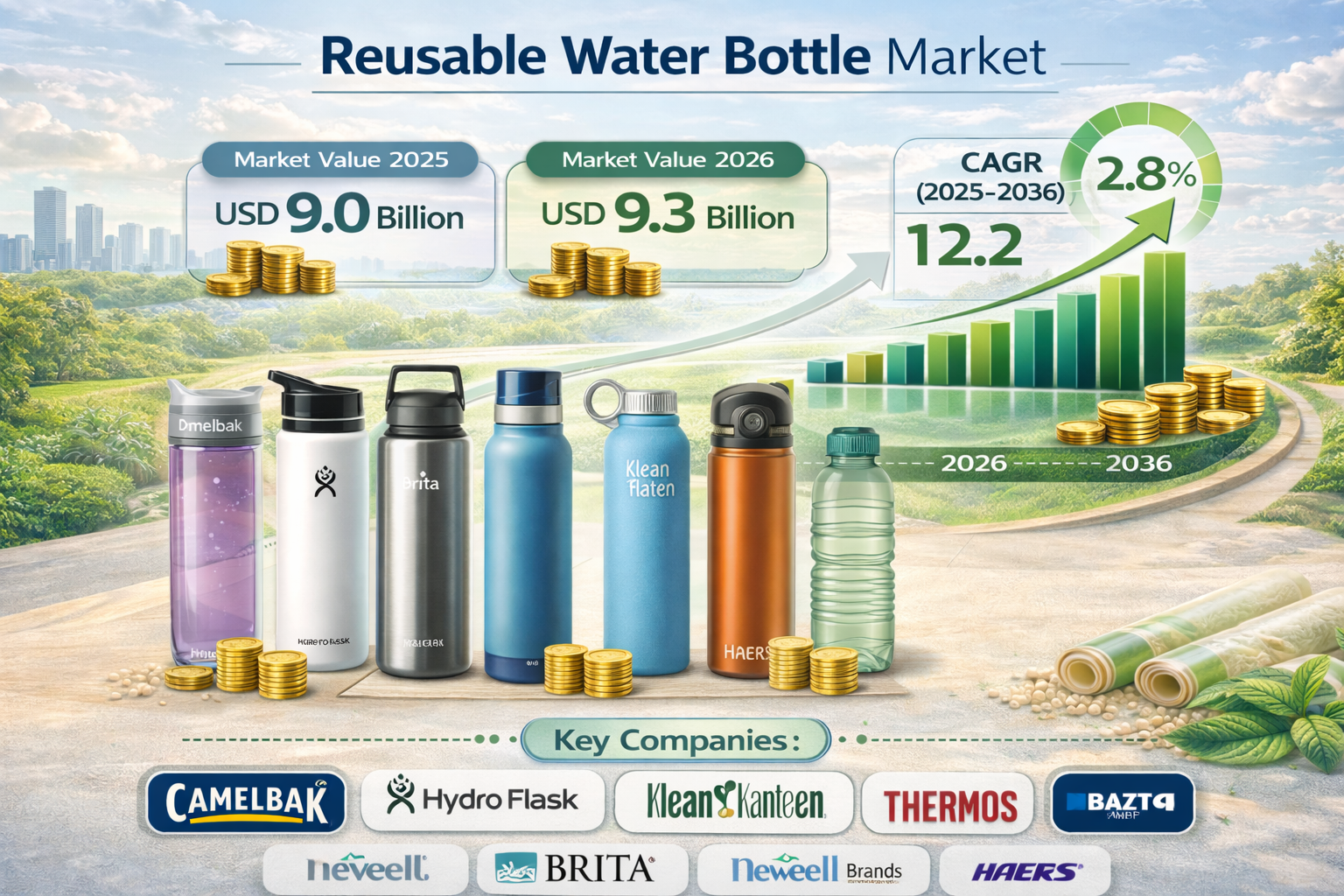
Reusable water bottle market to reach USD 12.2 billion by 2036, growing at a 2.8% CAGR from 2025, driven by rising sustainability trends.
NEW YORK, DE, UNITED STATES, February 25, 2026 /EINPresswire.com/ -- The Reusable Water Bottle Market was valued at USD 9.0 billion in 2025, rising to USD 9.3 billion in 2026, and is projected to reach USD 12.2 billion by 2036, expanding at a CAGR of 2.8% over the forecast period. Growth reflects tightening municipal bans on single-use plastics and accelerating compliance requirements reshaping hydration procurement.
Procurement surges during regulatory transition windows, compelling retailers to replace disposable inventory with durable hydration hardware. Corporate ESG mandates and advanced vacuum insulation technologies are further strengthening category resilience across retail and B2B channels.
• Market size in 2025 USD 9.0 billion
• Market size in 2036 USD 12.2 billion
• CAGR (2026–2036) 2.8%
• Leading material segment Metal/Stainless Steel (39.4% share in 2026)
• Leading distribution channel Hyper/Supermarkets (41.7% share in 2026)
• Leading primary usage Everyday usage (44.8% share in 2026)
• Fastest-growing country India (6.5% CAGR)
• Key companies Camelbak Products LLC; Hydro Flask (Helen of Troy Limited); Klean Kanteen, Inc.; Thermos LLC; Newell Brands; Brita GmbH; Zhejiang Haers Vacuum Containers Co. Ltd.
Market Momentum (YoY Path):
The Reusable Water Bottle Market expands from USD 9.0 billion in 2025 to USD 9.3 billion in 2026, reflecting compliance-driven procurement acceleration. By 2028, municipal bans across North America and Europe normalize durable hydration hardware across retail channels. Through 2030 and 2031, enterprise wellness procurement and corporate gifting volumes sustain steady value growth. By 2033, replacement cycles and smart hydration upgrades support incremental expansion. Ultimately, the market reaches USD 12.2 billion by 2036, underscoring durable hardware resilience despite broader macroeconomic headwinds.
Why the Market is Growing:
Growth in the Reusable Water Bottle Market is primarily driven by municipal bans on single-use plastics. Retailers must clear disposable inventory and restock compliant hydration alternatives to avoid regulatory penalties. Corporate ESG mandates redirect procurement toward durable, reusable vessels for employee gifting and wellness programs. Advanced vacuum insulation improves temperature retention expectations, reinforcing metal bottle adoption. Procurement concentration during compliance transition windows accelerates shelf replacement, benefiting brands with localized steel supply chains capable of preventing stock-outs.
Segment Spotlight:
1) Material Type: Metal/Stainless Steel (39.4%): Metal/Stainless Steel commands 39.4% share in 2026. Durability, superior thermal retention, and infinite recyclability align with corporate scope-3 emissions targets. Corporate event planners prioritize engravable metal surfaces for long-term brand visibility, while manufacturers secure closed-loop steel recovery networks to stabilize margins.
2) Distribution Channel: Hyper/Supermarkets (41.7%): Hyper/Supermarkets hold 41.7% share in 2026, leveraging floor space and tactile evaluation advantages. Retailers strategically position hydration hardware near checkout zones to capture impulse traffic. Big-box stores require standardized packaging formats to maximize shelf density and streamline restocking operations.
3) Primary Usage: Everyday (44.8%): Everyday usage captures 44.8% share in 2026, as hydration shifts from athletic contexts into workplace and commuting routines. Leak-proof engineering, cup-holder compatibility, and dishwasher-safe components sustain replacement cycles. Smart Bluetooth-enabled hydration bottles further elevate daily functionality.
Get Access of Report Sample: https://www.futuremarketinsights.com/reports/sample/rep-gb-15397
Drivers, Opportunities, Trends, Challenges
• Drivers: Strict municipal ordinances banning disposable PET packaging force structural shifts in retail hydration categories. Procurement windows create temporary demand spikes as non-compliant inventory is removed from shelves.
• Opportunities: Corporate wellness programs and ESG procurement budgets create bulk purchase channels. Digital integration through Bluetooth-connected bottles enables monetization via health applications and subscription services.
• Trends: Material provenance and verified recycled content act as competitive differentiators. Brands increasingly pivot from lifestyle messaging to carbon displacement metrics and lifecycle transparency.
• Challenges: High upfront unit costs limit immediate conversion among lower-income consumers. Economic inflation restricts discretionary spending, compelling brands to introduce entry-level polymer alternatives to broaden accessibility.
Competitive Landscape
The Reusable Water Bottle Market remains highly competitive, with material sourcing and sustainability verification acting as core differentiators. Brands that secure certified recycled steel or ocean-bound plastics command premium positioning and avoid retail delisting risks.
Key players include:
• Camelbak Products LLC
• Hydro Flask (Helen of Troy Limited)
• Klean Kanteen, Inc.
• Thermos LLC
• Newell Brands
• Brita GmbH
• Zhejiang Haers Vacuum Containers Co. Ltd.
Recent developments include BRITA Group’s commitment to achieve net zero emissions by 2050 and VisionBlue’s Ocean Cloud Warehouse initiative to enhance marine plastic logistics efficiency. Cross-industry collaborations are accelerating closed-loop manufacturing strategies.
FAQ:
What is the projected value of the Reusable Water Bottle Market by 2036?
The market is projected to reach USD 12.2 billion.
What is the forecast CAGR?
2.8% from 2026 to 2036.
Which material dominates the market?
Metal/Stainless Steel leads with 39.4% share in 2026.
Which distribution channel leads?
Hyper/Supermarkets with 41.7% share.
Which usage category is largest?
Everyday usage holds 44.8% share in 2026.
Why FMI: https://www.futuremarketinsights.com/why-fmi
Have a Look at Related Research Reports on the Packaging Domain:
Water Soluble Pods and Capsules Packaging Market: https://www.futuremarketinsights.com/reports/water-soluble-pods-and-capsules-packaging-market
Waterproof Label Market Share Analysis: https://www.futuremarketinsights.com/reports/waterproof-label-market-share-analysis
Water-Soluble Packaging Market Share Analysis: https://www.futuremarketinsights.com/reports/water-soluble-packaging-market-share-analysis
About Future Market Insights (FMI)
Future Market Insights, Inc. (FMI) is an ESOMAR-certified, ISO 9001:2015 market research and consulting organization, trusted by Fortune 500 clients and global enterprises. With operations in the U.S., UK, India, and Dubai, FMI provides data-backed insights and strategic intelligence across 30+ industries and 1200 markets worldwide.
Sudip Saha
Future Market Insights Inc.
+1 347-918-3531
email us here
Legal Disclaimer:
EIN Presswire provides this news content "as is" without warranty of any kind. We do not accept any responsibility or liability for the accuracy, content, images, videos, licenses, completeness, legality, or reliability of the information contained in this article. If you have any complaints or copyright issues related to this article, kindly contact the author above.
