

Stereo Microscopes Market is expected to Hit US$ 1.65 Billion by 2033 | DataM Intelligence
Stereo Microscopes Market
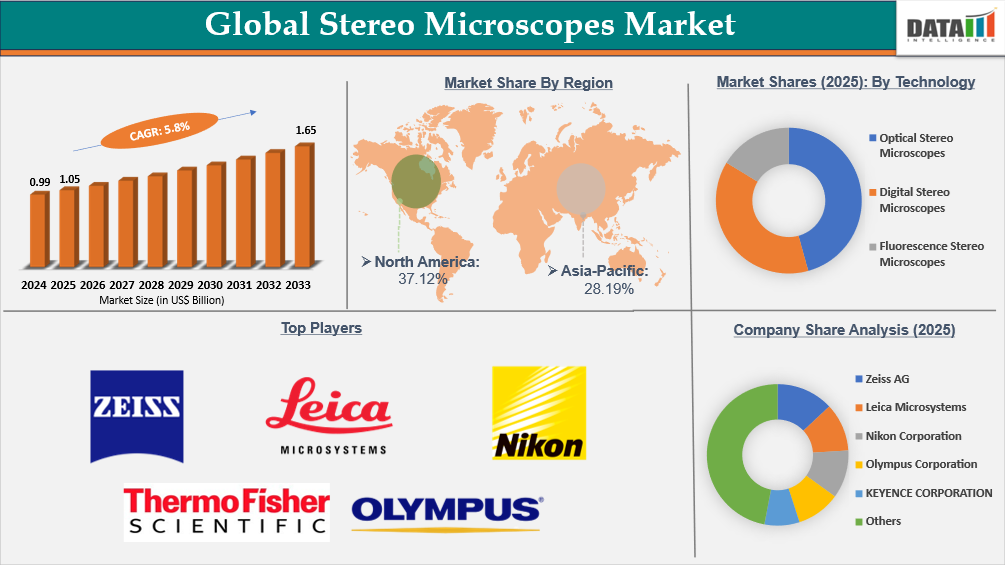
The Global Stereo Microscopes Market is expected to reach at a CAGR of 5.8% during the forecast period 2026 to 2033.
The Stereo Microscopes Market projected robust growth driven by demand in life sciences, electronics inspection & education; precision optics and digital integration key value drivers.”
AUSTIN, TX, UNITED STATES, February 25, 2026 /EINPresswire.com/ -- Market Overview:— DataM Intelligence
The Stereo Microscopes Market is witnessing steady expansion as precision-driven industries increasingly rely on advanced optical instruments for inspection, assembly, research, and quality control. Stereo microscopes, also known as dissecting microscopes, provide three-dimensional visualization at relatively low magnifications, making them ideal for applications in electronics manufacturing, life sciences, material testing, and educational laboratories. Their ability to offer depth perception and wide fields of view makes them indispensable for delicate manipulation tasks and detailed surface analysis.
To Download Sample Report Here: https://www.datamintelligence.com/download-sample/stereo-microscopes-market
According to DataM Intelligence, The Global Stereo Microscopes Market was valued at approximately USD 1.05 billion in 2025 and is projected to reach nearly USD 1.65 billion by 2033, growing at a CAGR of around 5.8% during the forecast period. Growth is primarily driven by expanding semiconductor production, increasing demand for quality inspection in automotive and aerospace sectors, and the rapid development of research infrastructure in emerging economies. The zoom stereo microscope segment currently leads the market due to its flexibility and variable magnification capabilities. Geographically, North America holds a dominant share, supported by strong R&D investments, advanced healthcare systems, and the presence of leading manufacturers, while Asia-Pacific is emerging as the fastest-growing region due to manufacturing expansion and electronics production hubs.
Key Highlights from the Report:
The Stereo Microscopes Market is projected to grow at a CAGR of 5.8% through 2033.
Zoom stereo microscopes account for the largest product segment share due to versatility in magnification.
Industrial inspection and semiconductor applications remain primary growth drivers.
North America leads the global market, while Asia-Pacific records the fastest growth rate.
Integration of digital imaging systems and camera attachments is transforming product innovation.
Educational and life sciences research sectors are expanding demand across emerging economies.
Market Segmentation:
The Stereo Microscopes Market can be segmented based on product type, application, end-user, and distribution channel. By product type, the market is divided into fixed magnification stereo microscopes and zoom stereo microscopes. Zoom stereo microscopes dominate the segment as they allow continuous magnification adjustments without changing lenses, making them highly efficient for laboratories and manufacturing environments. Fixed magnification microscopes remain popular in academic institutions due to their cost-effectiveness and ease of use.
In terms of application, stereo microscopes are widely used in industrial inspection, life sciences research, material science, forensic investigations, and electronics assembly. The industrial inspection segment holds the largest market share, driven by strict quality control standards in automotive components, semiconductor devices, and precision engineering. Life sciences research is also a key contributor, especially in biological dissection, entomology, and tissue examination.
By end-user, the market includes hospitals and diagnostic laboratories, academic and research institutes, industrial manufacturing units, and forensic laboratories. Industrial manufacturing units represent the leading end-user segment due to the growing need for microscopic inspection of printed circuit boards (PCBs), micro-components, and solder joints. Academic and research institutes form a strong secondary segment, supported by government funding for STEM education and research infrastructure.
Distribution channels typically include direct sales, distributors, and online platforms. Direct sales remain prominent among large industrial clients requiring customized optical solutions and technical support.
Speak to Our Analyst and Get Customization in the report as per your requirements: https://www.datamintelligence.com/customize/stereo-microscopes-market
Regional Insights:
North America leads the Stereo Microscopes Market, driven by advanced technological adoption, significant R&D funding, and strong presence of semiconductor and medical device manufacturers. The United States contributes the majority share within the region due to well-established laboratory infrastructure and demand for high-end digital stereo microscopes. The focus on automation and Industry 4.0 further accelerates adoption in manufacturing facilities.
Europe follows closely, supported by a robust automotive sector, aerospace engineering capabilities, and life sciences research activities. Countries such as Germany, France, and the United Kingdom demonstrate consistent demand for stereo microscopy solutions in precision engineering and biotechnology applications.
Asia-Pacific is the fastest-growing region in the global stereo microscopes industry. Rapid industrialization in China, Japan, South Korea, and India, combined with increasing electronics manufacturing and semiconductor fabrication plants, fuels regional demand. The region’s expanding academic institutions and government investments in scientific research further contribute to market growth.
Latin America and the Middle East & Africa represent emerging markets with moderate growth potential. Expansion of healthcare facilities and educational infrastructure in these regions is gradually supporting demand for cost-effective stereo microscopes.
Market Dynamics:
Market Drivers
One of the primary drivers of the Stereo Microscopes Market is the rapid growth of the semiconductor and electronics industries. Miniaturization of components requires precise inspection tools capable of delivering accurate depth perception and high-resolution imaging. Stereo microscopes are widely used for PCB inspection, soldering validation, and micro-assembly processes. Additionally, increasing quality standards in automotive and aerospace manufacturing necessitate reliable optical inspection systems.
Another significant driver is the expansion of life sciences research and biotechnology sectors. Stereo microscopes are extensively used for specimen dissection, cell culture observation, and micro-surgical procedures. Rising investments in medical research, especially in emerging economies, are strengthening demand. Furthermore, technological advancements such as LED illumination, digital camera integration, and ergonomic design enhancements are making stereo microscopes more efficient and user-friendly.
Market Restraints
Despite strong growth prospects, the market faces certain restraints. High costs associated with advanced digital stereo microscopes can limit adoption among small-scale laboratories and educational institutions. Maintenance costs and calibration requirements further add to operational expenses. Additionally, the availability of alternative imaging technologies, such as digital imaging software and automated optical inspection (AOI) systems, may reduce reliance on traditional stereo microscopes in certain applications.
Another challenge lies in the need for skilled professionals capable of operating advanced microscopy systems. In developing regions, limited technical expertise can slow down adoption rates.
Market Opportunities
Significant opportunities exist in the integration of digital technologies and automation features. The incorporation of high-definition cameras, image analysis software, and AI-powered defect detection systems can enhance the functionality of stereo microscopes. This digital transformation is particularly relevant in semiconductor fabrication and medical research.
Emerging economies offer untapped growth potential due to expanding manufacturing bases and research institutions. Government initiatives promoting domestic electronics production and scientific innovation are expected to create sustained demand. Furthermore, portable and compact stereo microscope models present opportunities for field-based research and on-site inspection tasks.
Looking For Full Report? Get it Here: https://www.datamintelligence.com/buy-now-page?report=stereo-microscopes-market
Frequently Asked Questions (FAQs):
How Big is the Global Stereo Microscopes Market in 2026?
What is the projected growth rate of the Stereo Microscopes Market through 2033?
Who are the key players in the global stereo microscopes industry?
Which region is expected to dominate the Stereo Microscopes Market during the forecast period?
What are the major growth drivers influencing the stereo microscopes industry trends?
Company Insights:
The Global Stereo Microscopes Market is moderately consolidated with several prominent manufacturers focusing on innovation and product differentiation. Key players include:
Zeiss AG
Leica Microsystems
Nikon Corporation
Olympus Corporation
KEYENCE CORPORATION
Motic Group
Meiji Techno America
Vision Engineering Ltd.
Thermo Fisher Scientific Inc.
Celestron
Recent Developments:
United States:
February 2026: Market analyses projected strong growth through AI analytics and predictive technologies, enhancing efficiency in quality control and research.
January 2026: Focus grew on optical stereo microscopes with innovations in ergonomic designs and digital integration for healthcare and electronics sectors.
December 2025: Research reports emphasized trends like AI-enabled inspection systems and sustainable manufacturing integration boosting stereo microscope adoption in industrial setups.
November 2025: The market showed steady expansion with projections highlighting integration of digital imaging and AI for precision applications in life sciences and semiconductors.
Japan:
February 2026: Emphasis on optical stereo advancements with better resolution and IoT connectivity for research and electronics applications.
January 2026: 3D stereo microscope market analyses forecasted AI-driven automation and data analytics improvements for high-tech industries.
December 2025: Projections noted rising demand for digital stereo models with high-precision imaging in manufacturing and biotech.
November 2025: Discussions highlighted AI integration into 3D stereo microscopes for semiconductor and biomedical research, aligning with Industry 4.0 initiatives.
Unlock 360° Market Intelligence with DataM Subscription Services: https://www.datamintelligence.com/reports-subscription
Conclusion:
The Stereo Microscopes Market is positioned for steady and sustained growth over the coming years, supported by advancements in electronics manufacturing, life sciences research, and industrial quality control processes. With increasing integration of digital imaging technologies and rising demand from emerging economies, the market is evolving beyond traditional optical systems toward smart, connected solutions. While cost challenges and alternative inspection technologies may pose limitations, ongoing innovation and expanding application areas are expected to drive long-term opportunities. As industries continue to prioritize precision, efficiency, and quality assurance, stereo microscopes will remain an essential tool across multiple sectors worldwide.
Related Reports:
Life Science Microscopy Device Market
Surgical Microscope Market
Sai Kiran
DataM Intelligence 4Market Research
+1 877-441-4866
Sai.k@datamintelligence.com
Visit us on social media:
LinkedIn
X
Legal Disclaimer:
EIN Presswire provides this news content "as is" without warranty of any kind. We do not accept any responsibility or liability for the accuracy, content, images, videos, licenses, completeness, legality, or reliability of the information contained in this article. If you have any complaints or copyright issues related to this article, kindly contact the author above.
