

Halogen-Free Flame Retardant Polymers Market Forecast 2026–2036: Market to Reach USD 8.2 Billion by 2036 at 7.9% CAGR
Halogen-Free Flame Retardant Polymers Market
E&E Components hold a 38% share; Phosphorus-based flame retardants command 42% of the material share.
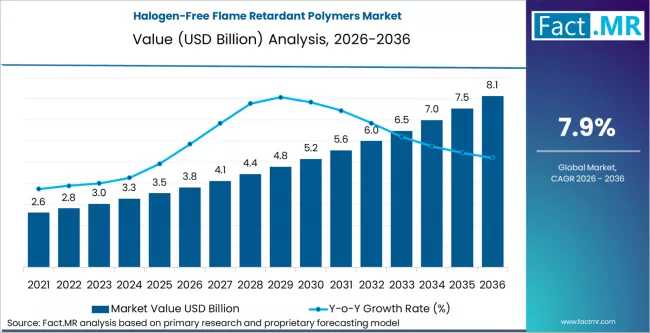
ROCKVILLE, MD, UNITED STATES, February 22, 2026 /EINPresswire.com/ -- The global halogen-free flame retardant polymers market is projected to grow from a valuation of USD 3.8 billion in 2026 to USD 8.2 billion by 2036. This steady expansion, representing a CAGR of 7.9%, is primarily fueled by regulatory value migration as electronics and automotive OEMs transition from legacy halogenated materials to compliant, high-performance alternatives.Get Access of Report Sample: https://www.factmr.com/connectus/sample?flag=S&rep_id=14330
global halogen-free flame retardant polymers market Snapshot
Market size 2026? The market is estimated to be valued at USD 3.8 billion.
Market size 2036? The market is projected to reach USD 8.2 billion.
CAGR? A compound annual growth rate of 7.9% is expected between 2026 and 2036.
Leading product segment(s) and shares? E&E Components hold a 38% share; Phosphorus-based flame retardants command 42% of the material share.
Leading material type and share? Phosphorus-based materials lead with a 42% market share.
Leading end use and share? Electronics is the top end-use industry with a 35% market share.
Key growth regions? Major growth is concentrated in China, the United States, Germany, and Japan.
Top companies? Key players include Lanxess AG, Clariant AG, ICL Group, Albemarle Corporation, and BASF SE.
Market Momentum (YoY Path)
The halogen-free flame retardant polymers market follows a trajectory of consistent incremental gains. Valued at USD 3.5 billion in 2025, the market rises to USD 3.8 billion in 2026. Continued adoption in EV infrastructure and consumer electronics is expected to push valuations to approximately USD 4.4 billion by 2028 and USD 5.2 billion by 2030. By 2031, the market continues its steady climb, eventually reaching USD 6.5 billion by 2033 and achieving its terminal forecast of USD 8.2 billion by 2036.
Why the Market is Growing
Growth is spearheaded by the EU Green Deal and Circular Economy Action Plan, which urge OEMs to eliminate toxic chemicals. The surge in Global EV production necessitates materials with high thermal stability for battery modules and charging connectors. Additionally, stricter international fire safety codes in construction are mandating low-smoke, halogen-free insulation for commercial high-rises.
Segment Spotlight
1) Product Type (Application)
E&E Components account for 38% of the market share. This dominance is due to rigorous regulatory enforcement under RoHS and the need for thin-wall housings (0.4-0.8mm) to meet UL 94 V-0 or 5VA fire safety ratings.
2) Material Type
Phosphorus-based systems hold a 42% share. These are preferred over mineral-filled alternatives because they achieve V-0 ratings at low loadings (10-18%), effectively preserving the mechanical strength and impact resistance of the base polymer.
3) End Use
The Electronics industry leads with a 35% share. With over 2.5 billion units of smartphones and laptops produced annually, major brands like Apple and Samsung mandate halogen-free specifications across their entire supply chains to ensure global compliance.
Drivers, Opportunities, Trends, and Challenges
Drivers: The primary engine of growth is the strict regulatory landscape, including the EU RoHS DecaBDE restriction and China’s GB 38031-2020 EV battery safety standards. These mandates force a systematic replacement of legacy brominated retardants with safer, halogen-free chemical packages.
Opportunities: The massive expansion of EV charging infrastructure and AI data center power systems presents a significant opening for high-voltage connectors. New product launches, such as halogen-free PBT compounds, are specifically designed to meet these emerging high-performance industrial needs.
Trends: There is a notable shift toward phosphorus-nitrogen synergy systems. These advanced technologies allow for lower additive loading while maintaining V-0 performance in thin-wall applications, moving away from bulky mineral fillers that previously limited design flexibility.
Challenges: Manufacturers face a ""regulatory versus performance"" hurdle. Halogen-free additives are often less efficient per unit weight than legacy systems, requiring sophisticated (and often 25-60% more expensive) formulations to maintain mechanical integrity without sacrificing fire safety.
Country Growth Outlook (CAGR)
Country CAGR (2026–2036)
China 12.5%
United States 11.8%
Germany 10.5%
Japan 9.8%
South Korea 11.2%
Competitive Landscape
The market is moderately concentrated at the additive level, dominated by Clariant, BASF, Lanxess, ICL, and Albemarle. However, the compounding market is fragmented with over 300 regional players. Competitive advantage is currently defined by the depth of UL 94 Yellow Card certifications, with vertically integrated producers leveraging proprietary phosphorus chemistry to secure long-term OEM contracts.
To View Related Report :
Medical Superabsorbent Polymers Market https://www.factmr.com/report/739/medical-superabsorbent-polymers-market
Silyl Modified Polymers Market https://www.factmr.com/report/1563/silyl-modified-polymer-market
Medical Polymers Market https://www.factmr.com/report/1801/medical-grade-polymers-market
Sugar Polymers Market https://www.factmr.com/report/3373/sugar-polymers-market
About Fact.MR
We are a trusted research partner of 80% of fortune 1000 companies across the globe. We are consistently growing in the field of market research with more than 1000 reports published every year. The dedicated team of 400-plus analysts and consultants is committed to achieving the utmost level of our client's satisfaction.
S. N. Jha
Fact.MR
+1 628-251-1583
email us here
Legal Disclaimer:
EIN Presswire provides this news content "as is" without warranty of any kind. We do not accept any responsibility or liability for the accuracy, content, images, videos, licenses, completeness, legality, or reliability of the information contained in this article. If you have any complaints or copyright issues related to this article, kindly contact the author above.
